Youth Spotlight
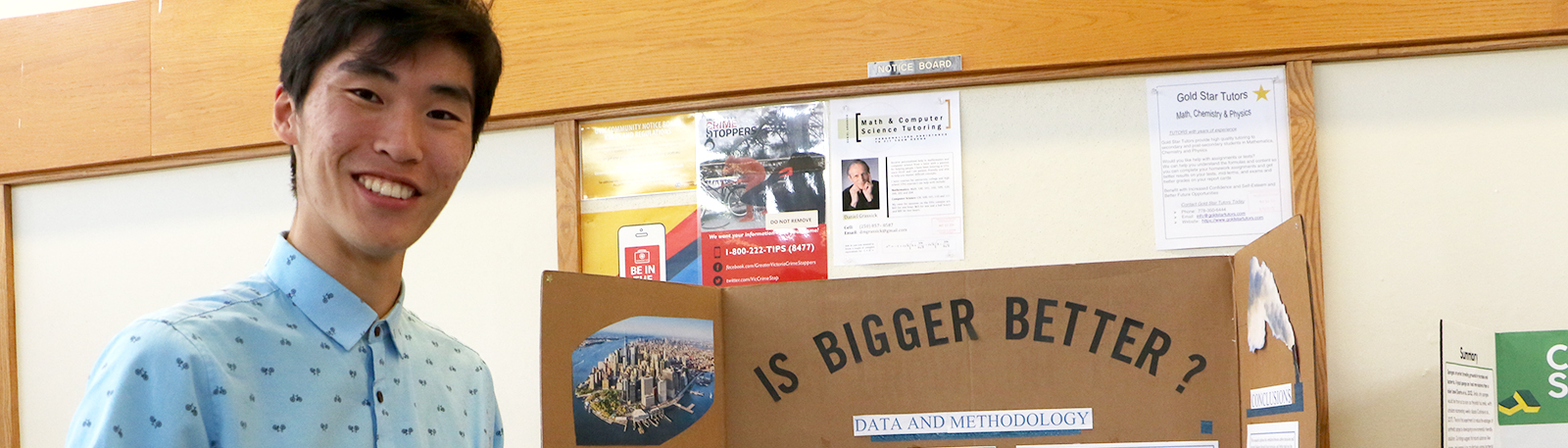
Richard Lee
Age: 18
School: Mount Douglas Secondary School, Vancouver Island
Next Step: Heading to the University of Toronto in the fall
What was your experience with science fairs?
It was an amazing opportunity — but not enough people know about them. I found out about science fairs through school and immediately thought they were something people only did in the movies. However, they turned out to be a really cool part of my high school experience, allowing me to dive deep into science in a well-organized and connected setting.
You participated in the Vancouver Island Regional Science Fair and made it to the Canada-Wide Science Fair. Can you tell me about the project that brought you there?
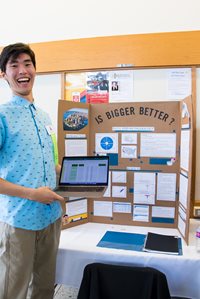
My project, “Is Bigger Better,” explored whether larger cities are more emissions-efficient than smaller ones. I analyzed carbon emissions and population data from Canadian and U.S. cities to determine the relationship between the two, using statistical analysis to assess factors like density, income, and temperature.
I discovered that large Canadian cities are less emissions-efficient than smaller ones, while large American cities are more efficient. As urban environments continue to grow, it’s crucial to understand how city size affects global warming. I believe my project resonated because it addressed a timely issue — climate change — through tangible, data-driven insights.
What was your inspiration behind the project?
With the rapid evolution of technology and innovation, I wanted to explore how our world can become more sustainable and efficient at scale. My passion for climate-focused projects was also fueled by what I noticed at science fairs — a lack of participation from public school students.
In 2023, I saw that most exhibitors came from private schools with more resources and awareness. That inspired me to start a Science Fair Club at my school to encourage participation. It worked — several students joined, and three placed in the top five in the senior category! Getting more public schools involved is key to promoting science fairs and leveling the playing field.
What advice would you give to students participating in YIS for the first time?
The image of science fairs can be misleading — they’re far more diverse and inclusive than people think. Don’t overcomplicate your project to impress others. I made that mistake the first time I reached Canada-Wide, and it only hurt my confidence.
Stick with your idea, trust your process, and focus on what excites you. Give it a shot, and be yourself.
Jora Singh Nahal
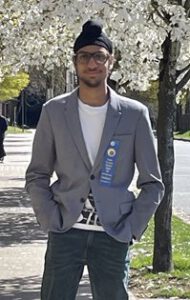
Age: 15
School: University Hill Secondary
What was your experience with science fairs? What has encouraged you to want to come back?
I have always had a strong passion for STEM since I was a child. I started participating in science fairs in grade 4, and these experiences allowed me to showcase my ideas to the world and enhance my communication skills through interactions with judges and mentors. They also provided valuable insights into entering the professional world—simulating real-life scenarios like client meetings.
The recognition I received for my work has motivated me to continue innovating and crafting science projects.
You participated in the Greater Vancouver Regional Science Fair and made it to the Canada-Wide Science Fair. Can you tell me about the project that brought you there?
For my first project in grade 7, I developed a drowsiness detection app titled “Drowsiness Detection and Virtual Friend Speech-Robot for Safe Driving.” The app tracks a driver’s eyes and alerts them if they are falling asleep. It was showcased at the Cariboo Mainline Regional Science Fair in Kamloops and won a bronze medal at the virtual Canada-Wide Science Fair (CWSF) during the pandemic.
My next project, DeviceABLE, is a novel hands-free computing app designed for people with disabilities. Hands-free computing is vital for individuals who cannot use their hands, but current solutions are often bulky, expensive, and less accurate. DeviceABLE provides a free, precise, and hardware-free alternative that allows users to control their computers through head movements and voice commands.
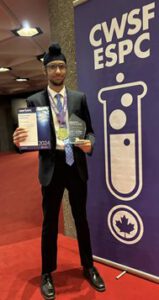
This project earned multiple awards at both the Greater Vancouver Regional Science Fair and CWSF. I’ve been participating in the Youth Innovation Showcase (YIS) since grade 8, and this marks my third project.
What was your inspiration behind the project?
The inspiration for my first project came from personal experience—seeing my mom struggle with drowsiness during long drives sparked the idea of creating an alert system for drivers. Knowing that drowsiness-related accidents are among the most fatal, second only to drunk driving, I wanted to find a practical way to prevent such incidents.
During the pandemic, with more time at home and online learning, I taught myself to code and began exploring hands-free computing for people with disabilities. With about 40% of motor-impaired individuals unable to use their hands, I recognized the need for accessible tools. DeviceABLE enables users to interact with their computers comfortably through head movements and voice control, reducing the limitations of traditional hardware.
The process of refining and improving the project has been incredibly rewarding and has driven my passion to keep innovating.
What project are you working on this year?
I’m continuing to develop DeviceABLE, but I plan to give it a significant upgrade to make it back to CWSF. By integrating artificial intelligence (AI), I aim to streamline user interaction, minimize manual effort, and enable automated functionalities that work seamlessly alongside the user.
What advice would you give to students participating in YIS for the first time this year?
Choose a project you’re truly passionate about—something that excites you and keeps you motivated throughout the process. Science fair projects require time and dedication, and it’s easier to stay committed when you genuinely enjoy your work.
Perseverance is key: results may not always be perfect, and multiple trials are often necessary. Focus on creating something you’re proud of. My two-year journey with DeviceABLE taught me the importance of resilience and continuous improvement.
Science fairs are not only fun and well-organized but also help build a strong community where lifelong friendships and professional connections are formed. My second time at CWSF in Ottawa was incredibly memorable, and I hope to go again. Once you’re part of this community, you can achieve great things together—the science fair world is more than just about science; it’s about collaboration, growth, and shared passion.
= 
Lorem ipsum dolor sit amet, consectetur adipiscing elit, sed do eiusmod tempor incididunt ut labore et dolore magna aliqua. Ut enim ad minim veniam, quis nostrud exercitation ullamco laboris nisi ut aliquip ex ea commodo consequat. Duis aute irure dolor in reprehenderit in voluptate velit esse cillum dolore eu fugiat nulla pariatur. Excepteur sint occaecat cupidatat non proident, sunt in culpa qui officia deserunt mollit anim id est laborum
Inbal Tzafrir
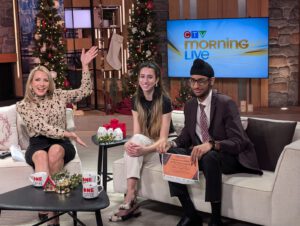
Age: 17
School: Delta Secondary School
What was your experience with science fairs?
I have had a passion for science since I was little and participated in many STEM-related programs, but my first official science fair experience came in 2024 at the South Fraser Regional Science Fair. It was an incredible opportunity to conduct research, present it to judges, receive meaningful feedback, and even win three special awards in the biomedical and coding categories.
Being the only student from my school to participate was a unique challenge, but it inspired me to expand the STEM Innovators Club I founded at my school — where I now encourage and mentor other students to get involved. Science fairs, to me, are a powerful platform for connection, innovation, and creativity, offering students early opportunities for research and entrepreneurship.
What was your inspiration behind the project with which you won the Youth Innovation Showcase?
The inspiration behind my project came from my sister’s experience with misophonia, a condition characterized by a limited tolerance to certain sounds or stimuli — such as eating noises. Diagnosed at 13, she faced significant challenges due to a lack of awareness, education, and accessible treatment options.
Motivated by the limited resources available, I began researching ways to raise awareness and improve accessibility for those living with misophonia. I spoke with patients, consulted mentors such as Dr. Goldberg from UBC’s Department of Psychology, and analyzed existing treatments. My goal was to design a user-friendly, affordable, and accessible solution that could fill the gaps in existing care.
This led to the creation of EaseApp, a mobile app designed to help combat misophonia. It integrates techniques inspired by Cognitive Behavioral Therapy (CBT) and auditory support methods, while remaining affordable and easy to use. I’m now working to gather feedback and improve its functionality for wider use.
What other projects are you working on this year?
In addition to my research, I founded Rosie’s Network, a non-profit STEM club for self-identifying female students. The organization connects high school mentors with elementary school students to inspire and empower girls in STEM fields.
We’ve already partnered with three elementary schools and reached over 300 students, and we’re now expanding the program district-wide. Rosie’s Network provides a space for mentorship, leadership, and growth — building confidence and inclusivity in science education.
What will you do with the money you won from YIS?
I plan to use the prize money to collaborate with medical institutions and healthcare researchers to expand our outreach. It will also help grow the Misophonia Wellness Society, the non-profit I co-founded alongside EaseApp, which provides a safe, educational, and supportive community through free and frequent support groups.
The funds will go toward further developing EaseApp, enabling collaboration with professionals in the medical and tech fields to enhance the app’s accessibility and impact.
What advice would you give to students participating in YIS for the first time this year?
Focus on a project that genuinely connects with you — something that feels personally meaningful and has real-world impact. Be creative, stay curious, and don’t be afraid to put yourself out there.
Approach the experience with passion and determination, and be open to feedback and collaboration. YIS is not just about science — it’s about community, learning, and growth. Use this opportunity to inspire others and spread awareness about the value of innovation.
What are your future plans, and where do you plan to take your projects?
As I begin university next year, I plan to major in biomedical engineering with a potential minor in business. I hope to continue developing EaseApp and expanding the Misophonia Wellness Society, while also growing Rosie’s Network into a larger organization that promotes female participation in STEM across the region.
Looking ahead, I’m excited to keep pursuing new research projects that merge technology, health, and social impact — creating change that helps people in tangible, meaningful ways.

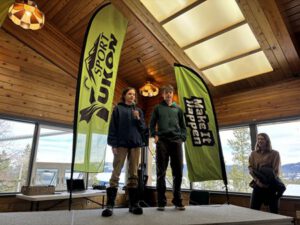
Sitka Land-Gillis

Age: 15
School: Centre Scolaire Secondaire Communautaire Paul-Émile (CSSC) Mercier
What was your experience with science fairs?
Last year, as part of a class project at Mercier, everyone was required to create a science project. Since I love skiing and spend about 15 hours a week training to ski as fast as possible, I decided to focus my project on optimizing ski performance.
I tested four different waxes under various conditions to determine which one performed best. The project ended up qualifying for the STEM Expo at Yukon University and even the Canada-Wide Science Fair (CWSF). It has been a fantastic experience combining my passion for skiing with science.
What was your inspiration behind the project you are going to the Canada-Wide Science Fair with?
The inspiration for my project, “Wax It to Win It: A Golden Algorithm for Team Canada,” came from the challenge of optimizing ski-wax selection in increasingly unpredictable snow conditions — a challenge intensified by climate change.
Last year, I worked with only one variable and four waxes, but the data was limited. This year, I expanded my scope to 13 waxes, 8 variables, and a robust testing process that generated 20 data points across 960 glide tests. I also incorporated 123 non-fluoro data points from Swix’s World Cup testing over the past two years, since fluoro waxes were banned for environmental reasons.
Collaborating with Team Canada’s lead wax technician, I refined the testing and analysis process. The result is a machine-learning algorithm that predicts the best wax based on snow conditions — providing an environmentally friendly, high-performance alternative to traditional waxes. Given that wax selection can cost thousands of dollars every weekend, the algorithm has the potential to make a significant impact.
What other projects are you working on this year?
I’ve been focusing on improving the algorithm for CWSF by testing and collecting additional data. So far, I’ve developed four versions using Python, which I learned through three online courses from Stanford and UMich.
My most recent version has achieved a 90 percent predictive accuracy, marking a major step forward in making data-driven wax selection practical for elite teams.
What advice would you give to students participating in science fairs for the first time this year?
Look around you and think about the things you enjoy doing — then ask how you could make them better or optimize them with science. Identify problems in your hobbies or environment and explore how science can help improve them. Passion makes research meaningful, and curiosity turns small ideas into breakthroughs.
What are your future plans, and where do you plan to take your projects?
My immediate goal is to refine the fourth algorithm and provide it to Team Canada ahead of the 2026 Winter Olympics, helping them reach the podium.
Beyond that, I plan to collect more data from other wax companies and ski clubs to enhance the model further. I also hope to integrate ski-base structure optimization into the process — combining physics, engineering, and data science to push ski performance to the next level.
Sreya Kurup
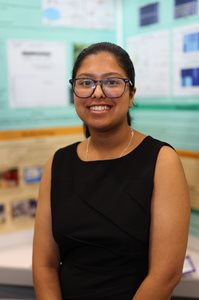
Age: 17 (Grade 11)
School: Surrey Schools
What was your experience with science fairs?
Last year, I participated in the South Fraser Regional Science Fair for the first time after discovering it through an Instagram post — which immediately sparked my interest. Before that, I didn’t even know science fairs existed!
Although balancing school, research, and independent exploration was a challenge, participating opened up incredible opportunities for me. My first year, I advanced to the Canada-Wide Science Fair (CWSF) and earned a Bronze Medal, which was an amazing experience and inspired me to continue.
This year, I returned to CWSF and earned Silver — a milestone that pushed me to keep learning and growing. Overall, science fairs have been a fantastic way to challenge myself, connect with others, and expand my understanding of science beyond the classroom.
What was your inspiration behind the project you are going to the Canada-Wide Science Fair with?
My project, “Antibiotic Resistance in S. aureus: Effects of Quorum Sensing Inhibition and DNA Fragmentation,” investigates antibiotic resistance in bacteria known for developing resistance to treatments. Using a dual-strategy approach, I combined conventional and natural compounds to analyze DNA fragmentation and resistance patterns.
My inspiration came from a personal experience — my mom developed a leg infection that kept worsening despite multiple antibiotic treatments. Seeing that struggle firsthand made me want to understand why antibiotic resistance happens and explore scientific ways to combat it.
What was your experience like at CWSF?
It has been amazing, and returning this year was truly an honour. The best part was connecting with like-minded students who share the same drive and curiosity. Everyone supports one another, and that sense of community has been one of the most rewarding aspects.
The experience inspired me to dive deeper into my passion for STEM and explore new opportunities within the field. Beyond the awards, the learning and relationships I’ve gained have been incredibly meaningful.
Note: Sreya received six entrance scholarships to university and a Silver Excellence Award in the Senior category for her project this year.
What other projects are you working on this year?
I’m currently brainstorming new topics within biomedical science, but I plan to continue expanding my current project — improving its methodology and exploring related areas within antibiotic resistance and treatment precision.
What advice would you give to students participating in science fairs for the first time this year?
Focus on narrowing your area of interest. Science is a huge field, so take time to explore and find what excites you most. If you’re unsure, start by reading and exploring different topics — that’s how I discovered my interest in cancer and bacterial research.
If one area doesn’t grab your attention, try another angle within the same field. For example, if studying genetic mutations doesn’t excite you, explore current therapies or real-world medical challenges instead. Defining your focus will help you create a project that’s both meaningful and motivating.
What are your future plans, and where do you plan to take your projects?
I plan to enhance antibiotic delivery systems to reduce resistance more efficiently and improve treatment precision and patient outcomes. My long-term goal is to contribute to medical innovation by developing solutions that make healthcare more effective and adaptable.
I also plan to pursue a STEM degree at university, where I can build the technical skills to advance my research and bring these ideas to life.
Lastly, I encourage students to reach out to professors or researchers — even if it feels intimidating. Cold emailing can open unexpected doors. Taking the initiative to connect and ask questions can lead to mentorship, lab opportunities, and valuable experience that goes far beyond the classroom.