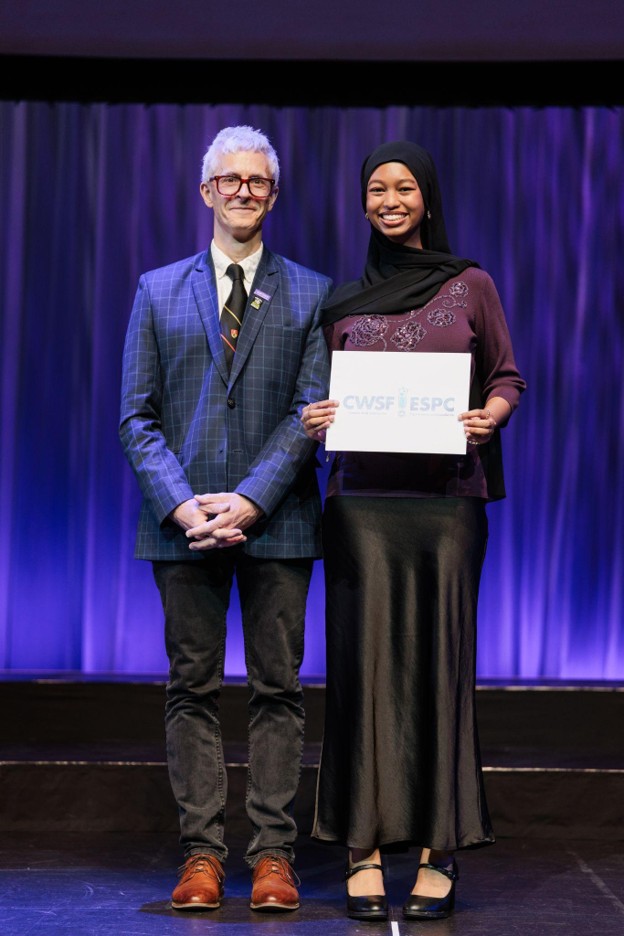
Youth Spotlight – Nadifa Omar
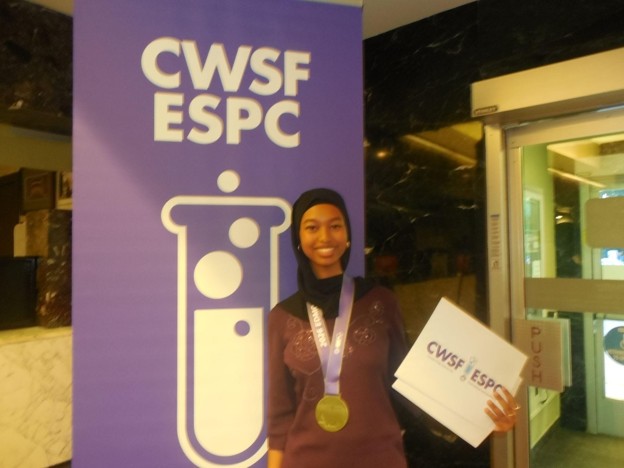
Age: Grade 12
School: Aberdeen Hall Preparatory School in Kelowna, BC
What was your experience with science fairs?
It's been really interesting. This was my first year participating in a fair in the Okanagan, and there hasn't been an original science fair here in over a decade. We had two spots representing the Okanagan at the Canada-Wide Science Fair and I was able to go as one of them.
What I took away most from it was meeting so many people who genuinely love science. That's rare. You don't often find a space where everyone shares that one passion, and getting to see so many different projects was such a fulfilling experience.
What was your inspiration behind your project, and what award did you win?
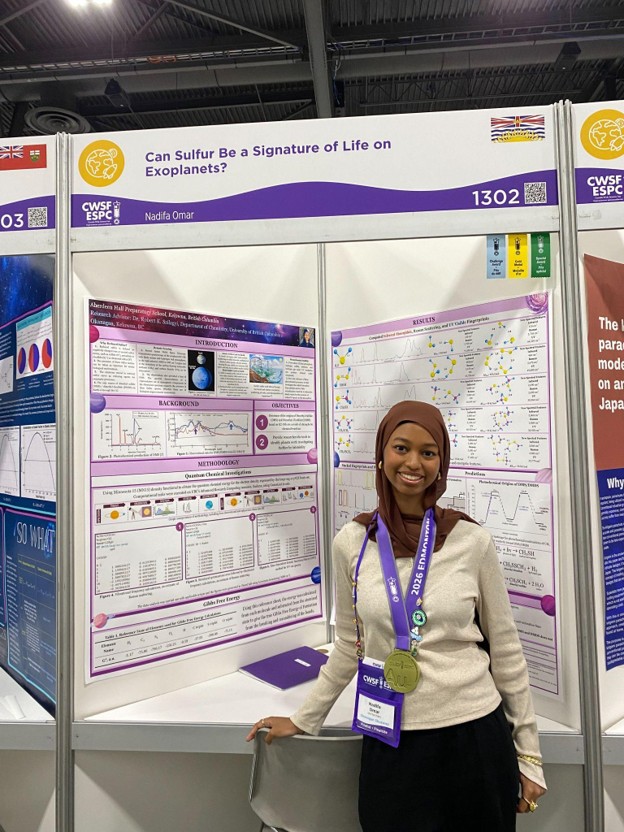
I've always been fascinated by the vastness of space and the possibility of life beyond Earth. I'd been reading through NASA research and astrobiology papers for a while, and I came across an article about the possibility of sulfur on Mars and how it could indicate life. Then researchers found two sulfur molecules in the atmosphere of exoplanet K2-18b that, on Earth, only originate from biological processes. I wanted to investigate whether those molecules could also have a non-biological origin. Through my research, I was able to eliminate one of the major non-biological pathways for producing that sulfur, which increases the possibility that life exists on that planet.
At the 2026 Canada-Wide Science Fair in Edmonton, I received the Excellence Award Gold, the Challenge Award in the Aerospace Senior category, and the CAP Physics Prize from the Canadian Association of Physicists, one of the first organizations to sponsor CWSF, which made that one especially meaningful, for my project “Can sulfur be a signature of life on exoplanets?”.
What other projects are you working on?
I'm expanding my current work into a database of spectral signatures that other researchers can use to analyze the atmospheres of other exoplanets. I'm also starting a new project focused on Saturn's moon and the possibilities of life beneath its ocean.
What advice would you give to students participating in science fairs for the first time?
Go in without expectations. I'd already been accepted to university before the fair, so I wasn't placing my worth on the outcome, and I think that made a huge difference. In a competitive environment, it's easy to get caught up in the rankings and be really hard on yourself. But just showing up is an accomplishment. Focus on the experience: the people you meet, the projects you see, what you learn. The awards are great, but they're not the whole point.
What are your future plans?
I'll be studying Astrophysics and Math at Columbia University, where I've been awarded the Rabi Scholars program. I plan to continue this line of research - there's so much more to explore when it comes to the chemical signatures of life on other worlds.