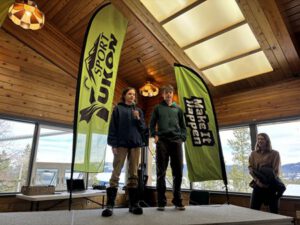
Youth Spotlight – Sitka Land-Gillis
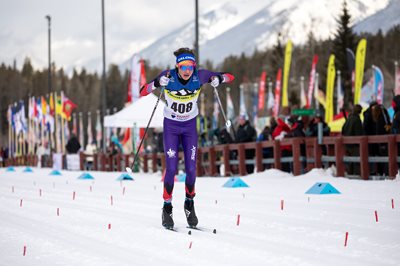
Age: 15
School: Centre Scolaire Secondaire Communautaire Paul-Émile (CSSC) Mercier
What was your experience with science fairs?
Last year, as part of a class project at Mercier, everyone was required to create a science project. Since I love skiing and spend about 15 hours a week training to ski as fast as possible, I decided to focus my project on optimizing ski performance.
I tested four different waxes under various conditions to determine which one performed best. The project ended up qualifying for the STEM Expo at Yukon University and even the Canada-Wide Science Fair (CWSF). It has been a fantastic experience combining my passion for skiing with science.
What was your inspiration behind the project you are going to the Canada-Wide Science Fair with?
The inspiration for my project, “Wax It to Win It: A Golden Algorithm for Team Canada,” came from the challenge of optimizing ski-wax selection in increasingly unpredictable snow conditions — a challenge intensified by climate change.
Last year, I worked with only one variable and four waxes, but the data was limited. This year, I expanded my scope to 13 waxes, 8 variables, and a robust testing process that generated 20 data points across 960 glide tests. I also incorporated 123 non-fluoro data points from Swix’s World Cup testing over the past two years, since fluoro waxes were banned for environmental reasons.
Collaborating with Team Canada’s lead wax technician, I refined the testing and analysis process. The result is a machine-learning algorithm that predicts the best wax based on snow conditions — providing an environmentally friendly, high-performance alternative to traditional waxes. Given that wax selection can cost thousands of dollars every weekend, the algorithm has the potential to make a significant impact.
What other projects are you working on this year?
I’ve been focusing on improving the algorithm for CWSF by testing and collecting additional data. So far, I’ve developed four versions using Python, which I learned through three online courses from Stanford and UMich.
My most recent version has achieved a 90 percent predictive accuracy, marking a major step forward in making data-driven wax selection practical for elite teams.
What advice would you give to students participating in science fairs for the first time this year?
Look around you and think about the things you enjoy doing — then ask how you could make them better or optimize them with science. Identify problems in your hobbies or environment and explore how science can help improve them. Passion makes research meaningful, and curiosity turns small ideas into breakthroughs.
What are your future plans, and where do you plan to take your projects?
My immediate goal is to refine the fourth algorithm and provide it to Team Canada ahead of the 2026 Winter Olympics, helping them reach the podium.
Beyond that, I plan to collect more data from other wax companies and ski clubs to enhance the model further. I also hope to integrate ski-base structure optimization into the process — combining physics, engineering, and data science to push ski performance to the next level.